
APALA

  • About
    • National Executive Board
    • National Staff
    • Opportunities
    • Our Work >
      • Young Leaders Council
    • Contact us
  • Convention
    • 2025 Convention
    • 2023 Convention
  • Join APALA
  • Take Action
    • Subscribe to Newsletter
    • Donate
    • Labor Toolkit on Anti-Asian Racism
  • Media
    • Publications
    • Press Releases
    • AANHPI Worker Stories
    • APALA in the News
  • APALA Archives
  • Shop
  • About
    • National Executive Board
    • National Staff
    • Opportunities
    • Our Work >
      • Young Leaders Council
    • Contact us
  • Convention
    • 2025 Convention
    • 2023 Convention
  • Join APALA
  • Take Action
    • Subscribe to Newsletter
    • Donate
    • Labor Toolkit on Anti-Asian Racism
  • Media
    • Publications
    • Press Releases
    • AANHPI Worker Stories
    • APALA in the News
  • APALA Archives
  • Shop

Press Releases

Coalition of AAPI Organizations Call on the Senate to Support the Sentencing Reform and Corrections Act

4/19/2016

 
Washington, DC – Asians Americans and Pacific Islanders (AAPIs) Beyond Bars, a coalition of Asian American and Pacific Islander (AAPI) organizations, community leaders, and directly impacted individuals, join 39 organizations in an effort to improve the lives of incarcerated and formerly incarcerated people. Particularly, they are calling on Senate Majority Leader Mitch McConnell to bring up a vote on the Sentencing Reform and Corrections Act (S. 2123), and for all Senators to support the bill.
“As a nation, we need to make criminal justice reform a priority especially as young people of color that come from immigrant, poor, and working class families, and communities become further disproportionately impacted by our country's ’tough on crime’ policies and perpetual school to prison to deportation pipeline,” said Minh Nguyen, Executive Director of VAYLA based in New Orleans, LA. "Bringing the Sentencing Reform and Corrections Act to the senate floor for a vote would mark a step forward for the many communities fighting for comprehensive criminal justice reform policies in this country. We are committed to this fight to dismantle the system of oppression for the long haul and will continue to organize to ensure racial, gender and economic justice for all.
In the last thirty years alone, America's prison population has grown from 500,000 during the 1980s to the 2.2 million incarcerated people today1. As a result, the United States now shares 25% of the world's prison population2. Specifically for AAPI communities, the prison population has increased by 250% from 1990 to 20003.
"We understand that the Southeast Asian and broader AAPI narrative is continuously overlooked in debates surrounding criminal justice reform. From high poverty rates, high school dropout rates, a history of trauma, criminalization, and an increase in deportation rates, the experiences of Southeast Asian communities pose a unique challenge for the many policy makers who have little to no understanding of the nuanced experiences of the larger AAPI population," said Cat Bao Le in Charlotte, NC, Southeast Asian Coalition's Executive Director. 
In December 2015, Asian Americans Advancing Justice-Los Angeles, Asian Pacific American Labor Alliance, AFL-CIO (APALA), Asian Prisoner Support Committee, National Education Association and Southeast Asia Resource Action Center (SEARAC) published “AAPIs Behind Bars”, a first of its kind report on how the school-to-prison-to-deportation impacts AAPI communities. View the report: http://bit.ly/AAPIsBehindBars 
"As a community organization that supports formerly incarcerated AAPIs and works to end mass incarceration and the criminalization of people of color, API RISE is proud to stand with others in the AAPI community to call on Senator McConnell to bring up a vote on the Sentencing Reform and Corrections Act (S. 2123). Given many AAPIs in prison were juveniles sentenced as adults, we hope that this is just the beginning and that future efforts will be able to impact more men and women regardless of their crimes," said Duc Ta of Asian Pacific Islander Re-Entry and Inclusion Through Support and Empowerment (API RISE) based in Los Angeles, CA.
APALA Nevada’s Ray Takeda & member of International Brotherhood of Electrical Workers (IBEW) added, "We will continue to engage our communities in Las Vegas, throughout the state and across the country to pass S. 2123 and move sentencing and broader criminal justice reform. It is especially important for our communities to stand together on this issue if we are to ever create a system of restorative justice for all."
The full letter sent to Senate Majority Leader Mitch McConnell can be found here:http://bit.ly/1RWP4iq
1 The Sentencing Project, “Trends in U.S. Corrections”:http://sentencingproject.org/doc/publications/inc_Trends_in_Corrections_Fact_sheet.pdf 
2 American Civil Liberties Union, “The Prison Crisis”:https://www.aclu.org/prison-crisis   
3 Oh, A., and Umemoto, K. AAPIs: From incarceration to re-entry. Amerasian Journal. 2005;31(3):43-59
###
APALA Joins AFL-CIO and #FREEAMERICA in Washington Prison Visit and Larger Fight to End Mass Incarceration

4/8/2016

 
​Washington, DC – On April 7, 2016 APALA National President Johanna Puno Hester, National Secretary Tracy Lai and Executive Director Gregory Cendana joined the AFL-CIO, #FREEAMERICA and artist John Legend on a prison visit to the Washington Corrections Center for Women in order to have a deeper conversation around the role of the labor movement in ending mass incarceration.

“APALA is proud to stand alongside the AFL-CIO and #FreeAmerica in our collective fight to end mass incarceration and the criminalization of our communities, particularly people of color,” said Gregory Cendana, APALA Executive Director. “For AAPIs specifically, the prison population has grown 250% since the ‘90s yet there continues to be gaps in data and research necessary for the voices of AAPI communities to be heard in the larger conversations around criminal justice reform.”

Just this past December, APALA, alongside Asian Americans Advancing Justice-Los Angeles, Asian Prisoner Support Committee, National Education Association and Southeast Asia Resource Action Center, published a policy report titled “AAPIs Behind Bars” in an effort to expose the school-to-prison-to-deportation pipeline that exists.

“The harsh immigration policies passed in 1996 have left Southeast Asian communities with refugee and legal status vulnerable for deportation based on past criminal records. These policies have subjected immigrant youth to multi-generational poverty, racial profiling, over policing inside the school, and mass incarceration, which in turn have ended in the deportation and separation of families,” said Tracy Lai, APALA National Secretary and member of the American Federation of Teachers.

The report was written following a convening held at California’s San Quentin State Prison offering a number of policy recommendations that would better serve the needs of incarcerated AAPIs. Recommendations included investing in and developing culturally competent programs that address intergenerational trauma, promoting restorative justice and healing models, providing prisoners access to a college education, repealing the 1996 Illegal Immigration Reform and Immigrant Responsibility Act (IIRIRA), and expanding reentry pipelines for formerly incarcerated people.

“APALA’s leadership has been integral to moving the broader labor movement forward on criminal justice reform,” stated Carmen Berkley, Director of the Civil, Human and Women’s Rights Department of the AFL-CIO. “Their values of centering the work around those disproportionately impacted, organizing at the intersections and utilizing art and culture has been transformational to how unions will engage in this work.”

“There is a vicious cycle of incarceration and poverty across all communities. We need to do better in helping support our formerly incarcerated Brothers and Sisters by expanding prison-to-job pipelines that foster social entrepreneurship and create pathways to jobs with living wages, healthcare and a voice at work." said APALA National President Johanna Puno Hester  and an American Federation of State, County and Municipal Employees (AFSCME) International Vice President. "This starts by implementing ‘Ban the Box’ policies in the hiring process at every state and federal level. It means looking at workers beyond their past criminal records and recognizing the unique skills and abilities many bring."  
​
The complete policy report can be found at bit.ly/AAPIsBehindBars. To learn more about #FreeAmerica, visit LetsFreeAmerica.com.  
###

National Asian American, Pacific Islander, and Ally Groups Discuss Impact of Mass Criminalization on AAPI Community 

12/3/2015

 
Picture
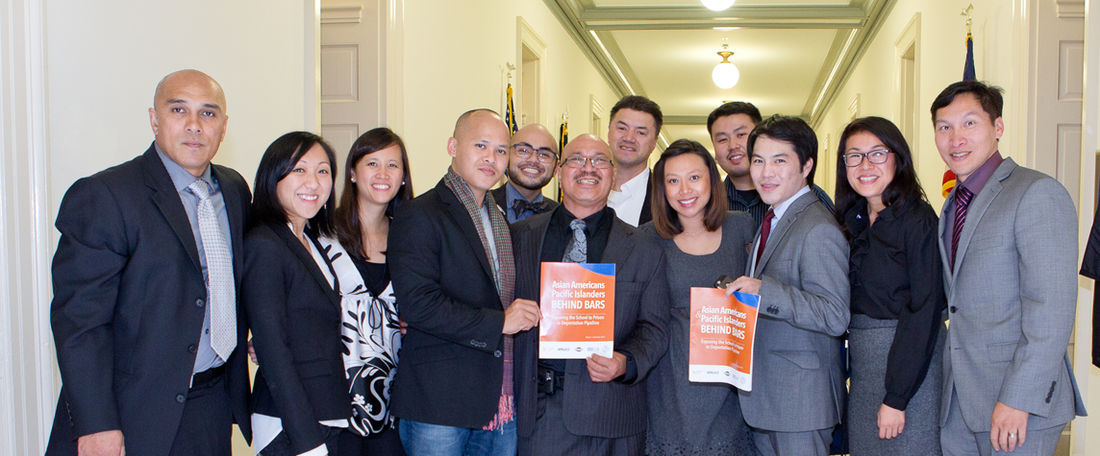
​(Washington, DC) – During a Congressional briefing at Cannon House Office Building yesterday, national advocacy organizations representing Asian American and Pacific Islander (AAPI) groups and their allies shared a policy report on the impact of mass incarceration on the AAPI community entitled “AAPIs Behind Bars: Exposing the School to Prison to Deportation Pipeline.”

Discussing the impact of mass incarceration and mass criminalization within the AAPI community, the policy report was created after a historic convening held in June 2015 inside the walls of San Quentin State Prison in Northern California. The June gathering had connected more than 100 leaders, including activists, funders, lawmakers, policy experts, and community members, with actively incarcerated AAPI prisoners.

Yesterday’s Congressional briefing included remarks from Reps. Judy Chu (CA-27, CAPAC chair) and Bobby Scott (VA-3). Rep Barbara Lee (CA-13) attended the event to meet with impacted members from her district. In addition, formerly incarcerated individuals and those with pending deportation orders were invited to reflect on their personal experiences.

ABOUT THE AAPIS BEHIND BARS POLICY REPORT
Written in collaboration with the prisoners enrolled in an APSC transformation and racial healing program called Restoring Our Original True Selves (ROOTS), the report offered a number of policy recommendations that would better serve the incarcerated AAPI community, including the implementation of culturally competent programs, reformation of sentencing laws, reinstitution of Pell grants to fund prisoners’ college educations, repeal of the 1996 Illegal Immigration Reform and Immigrant Responsibility Act, and the creation of a prison-to-jobs pipeline, among others.

Officially categorized as "Others" throughout much of the prison system, AAPIs represent a population that is often overlooked. In 2013, there were 118,100 "Others" in the state and federal prison system, comprising 9% of the state and federal prison system.1 During the prison boom of the 1990s, the AAPI prisoner population grew by 250%, while disaggregated data shows that certain Asian subgroups, such as Southeast Asian Americans and Pacific Islanders, have significantly high rates of arrest and incarceration.1 Closely tied to the rise of mass incarceration is the growth of immigration detention and deportation, which has increased for AAPIs overall, and Southeast Asian Americans in particular. In fact, Southeast Asian American communities are three to four times more likely to be deported for old convictions, compared to other immigrant communities.2 Incarcerated AAPIs also experience unique challenges, including cultural stigmas, lack of community awareness, and disownment from their families.

ABOUT THE CONGRESSIONAL BRIEFING
The briefing was hosted by Asian Americans Advancing Justice - LA (AAAJ-LA), Asian Pacific American Labor Alliance / AFL-CIO (APALA), Asian Prisoner Support Committee (APSC), the National Education Association (NEA), the Southeast Asia Resource Action Center (SEARAC) and the National Council on Asian Pacific Americans (NCAPA), in collaboration with the Congressional Asian Pacific American Caucus (CAPAC).

Moderated by Paul Jung, of AAAJ-LA, the panel of formerly incarcerated individuals included Naroen Chhin, 1Love Movement, Philadelphia; Lundy Khoy, SEARAC, D.C.; David Kupihea, API Rise, Los Angeles; Kristopher Larsen, Formerly Incarcerated Group Healing Together (FIGHT), Seattle; Harrison Seuga, APSC, Oakland; and Eddy Zheng, APSC, Oakland.
​
Panelists shared stories of events that profoundly impacted their lives, from being born in refugee camps, growing up in poverty, enduring sexual abuse, and being victimized by bullying. They also stressed the importance of education both inside and outside prison walls, and called for the AAPI community to come together to fight the cycle of injustice collectively.

“The Southeast Asian American narrative continues to be overlooked in the debate for more humane criminal justice laws. These refugee communities face overwhelmingly high rates of poverty, school push-out, mental health disorders, and criminalization, as a result of their unique history of trauma. The failure to understand these challenges have led to an increasing number of prisoners being funneled from detention to deportation—a reality our lawmakers must understand if they are truly committed to creating a system of restorative justice for all."
 Quyen Dinh, Executive Director 
Southeast Asia Resource Action Center (SEARAC)

“Not only do we have to work to fix our broken prison system, we have to work to fix our immigration system.”
US Rep Judy Chu 
CA-27 

“Following the first-ever AAPI Behind Bars convening last summer, the Asian Pacific American Labor Alliance (APALA) will continue to engage key stakeholders, allies, formerly and currently incarcerated people, as well as unions and the broader labor movement, to disrupt the school-to-prison-to-deportation pipeline. We must find ways to create a pathway for rehabilitation and restorative justice for individuals who are part criminal justice system. APALA will continue to prioritize mass employment and education while organizing to dismantle the mass incarceration structure that criminalizes people of color in America.”
Gregory Cendana, National Executive Director 
Asian Pacific American Labor Alliance (APALA)

 “Our incarceration rate is so big that it’s counterproductive.”
US Rep Bobby Scott 
VA-3

“During the past decades, we've witnessed an unprecedented number of youth of color incarcerated in this country. The current narrative lacks the visibility of Southeast Asian, Native Hawaiian, and Pacific Islanders who are disproportionately impacted by this era of mass incarceration. And consequently, culturally relevant services at various points of contact—whether in schools, communities, jails, prisons, and immigration detention center—-are severely lacking for these populations. If we truly desire a meaningful second chance for those who are directly impacted, then a paradigm shift toward a more inclusive, rehabilitative approach needs to happen now.”

Paul Jung, Staff Attorney 
Asian Americans Advancing Justice | Los Angeles 
“As educators, our members are intimately aware that the model minority myth not only harms the AAPI community by preventing our schools from building the much needed infrastructure to support AAPI students, but it also contributes to the mass criminalization and incarceration of AAPI youth, which is a problem that has largely been ignored. Our legislators must address the horrible effect of broken policies and a lack of inclusion and support for this community. If we don’t talk about it, we’ll never be able to offer resources to eradicate the problem or provide opportunities accessible to all.”
Merwyn Scott, Director of Minority Community Organizing & Partnerships 
National Education Association (NEA)

“As a formerly incarcerated person who has spent 21 years behind bars, I am intimately aware of the detrimental impact incarceration and deportation have on me, my family, and my community. The Asian American and Pacific Islanders’ (AAPI) migration to the school-to-prison-and-deportation pipeline conflicts with the model minority myth due to cultural shame and stigma within the community. As the country is embarking on finding alternatives and solutions to mass incarceration, it is imperative that currently and formerly incarcerated people are included in the process. I hope this Congressional briefing will inspire people and policymakers to learn about the challenges of AAPIs behind bars and advocate for resources to provide disaggregated data and invest in mass education and employment for all people.”
Eddy Zheng, Co-Chair 
Asian Prisoner Support Committee (APSC)

To access the full report, "AAPIs Behind Bars: Exposing the School to Prison to Deportation Pipeline," click here.

REFERENCES
1. Carson, E.A. Prisoners in 2013. Washington, DC: US Department of Justice Bureau of Justice Statistics, 2014. Available at: http://www.bjs.gov/content/pub/pdf/p13.pdf, Accessed 16 November 2015.
2. Transactional Records Access Clearinghouse [online]. Syracuse, NY: Syracuse University, 2015. Available at: trac.syr.edu/phptools/immigration/court_backlog/deport_outcome_charge.php. Accessed 25 August 2015.

CONTACTS:
Asian Americans Advancing Justice - LA
Paul Jung, [email protected], (213) 453-0433
Asian Pacific American Labor Alliance (APALA)
William Chiang, [email protected], (202) 508-3733
Asian Prisoner Support Committee
Eddy Zheng, [email protected], (415) 298-1833
National Education Association
Monica Thammarath, [email protected], (202) 421-1547
Southeast Asia Resource Action Center (SEARAC)
Katrina Dizon Mariategue, [email protected], (202) 601-2968
###
Forward>>

    For Immediate Release

    Contact:
    info[at]apala.org

    For full list of all press releases and statements, please click here.

    ​

    Archives

    August 2025
    May 2024
    November 2023
    August 2023
    June 2023
    April 2023
    March 2023
    February 2023
    January 2023
    December 2022
    November 2022
    September 2022
    August 2022
    June 2022
    May 2022
    April 2022
    January 2022
    December 2021
    November 2021
    October 2021
    September 2021
    August 2021
    April 2021
    March 2021
    February 2021
    January 2021
    December 2020
    November 2020
    October 2020
    September 2020
    August 2020
    July 2020
    June 2020
    May 2020
    April 2020
    March 2020
    February 2020
    January 2020
    November 2019
    August 2019
    July 2019
    June 2019
    April 2019
    March 2019
    February 2019
    January 2019
    December 2018
    November 2018
    October 2018
    September 2018
    August 2018
    June 2018
    May 2018
    March 2018
    January 2018
    December 2017
    November 2017
    October 2017
    September 2017
    August 2017
    July 2017
    June 2017
    May 2017
    April 2017
    March 2017
    February 2017
    January 2017
    December 2016
    November 2016
    October 2016
    September 2016
    August 2016
    July 2016
    June 2016
    May 2016
    April 2016
    March 2016
    February 2016
    January 2016
    December 2015
    November 2015
    October 2015
    September 2015
    August 2015
    May 2015
    April 2015
    January 2015
    November 2014
    October 2014
    August 2014
    July 2014
    June 2014
    April 2014
    February 2014
    January 2014
    December 2013
    April 2013
    May 2012
    April 2012
    March 2012
    February 2012
    January 2012
    April 2011
    February 2011
    August 2007

    Categories

    All
    2016 Election
    AAPI Behind Bars
    AAPIs Beyond Bars
    #AAPIsResist
    Affirmative Action
    APAHM
    #BlackLivesMatter
    Black Lives Matter
    Civic Engagement
    Convention
    Corporate Accountability
    Criminal Justice Reform
    DACA
    DOL
    DREAMERs
    Economic Justice
    Education
    End Islamophobia
    Endorsements
    Every Vote Counts
    Gender Justice
    Gun Control
    Gun Violence
    Hate Crime
    Healthcare
    Health & Safety
    Immigration
    International Solidarity
    Leadership
    LGBTQ
    Living Wage
    Mass Criminalization
    Mass Incarceration
    National Executive Board
    NHPI
    Not Your Model Minority
    Police Brutality
    POTUS
    Racial Justice
    Reproductive Justice
    #ResistTrump
    Right To Organize
    SCOTUS
    TPP
    Trade Justice
    Unemployment
    Voter Education And Mobilization
    Women's Rights
    Workers' Rights
    Young Leaders Council

    RSS Feed

Asian Pacific American Labor Alliance
815 16th St. NW, 2nd Floor
Washington, DC 20006
202-800-5811 | [email protected]

​Contact Us
Founded in 1992, the Asian Pacific American Labor Alliance (APALA), AFL-CIO, is the first and only national organization of Asian American, Native Hawaiian and Pacific Islander (AANHPI) workers, most of whom are union members and our allies, building power for AANHPI workers and communities.
Quick Navigation
About | Our Work | Chapters | Take Action | Media & Resources 
| Shop | Privacy Policy